
University of Sydney · Robotics, Learning & Control
Computational methods for curious robots
We develop rigorous mathematical, algorithmic, and optimization methods for robotic learning and control. Led by Dr. Ian Abraham.
Latest Work
New papers and preprints from the lab. The full list lives on our publications page.
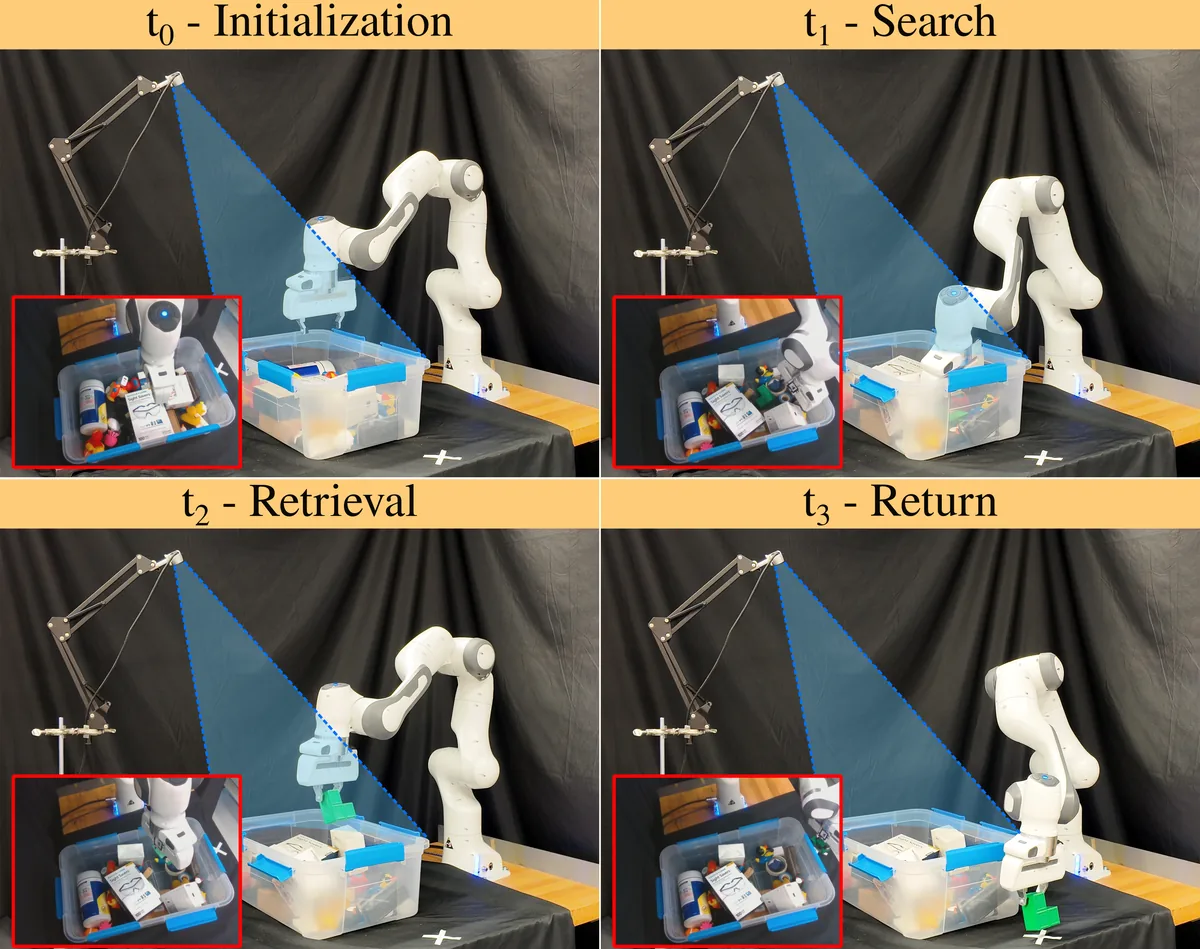 Time-Optimal Ergodic Retrieval
Read paper
Time-Optimal Ergodic Retrieval
Read paper
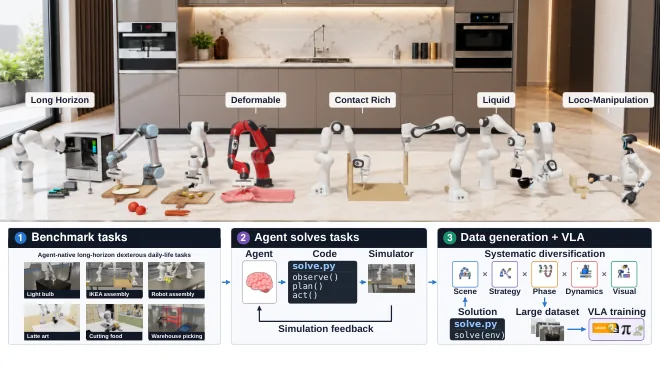 EmbodiedSWE: Coding Agents for Long Horizon Dexterous Robotics
Read paper
EmbodiedSWE: Coding Agents for Long Horizon Dexterous Robotics
Read paper
 Accelerating Visual Policy Learning with Sampling-Based Model Predictive Control
Read paper
Accelerating Visual Policy Learning with Sampling-Based Model Predictive Control
Read paper
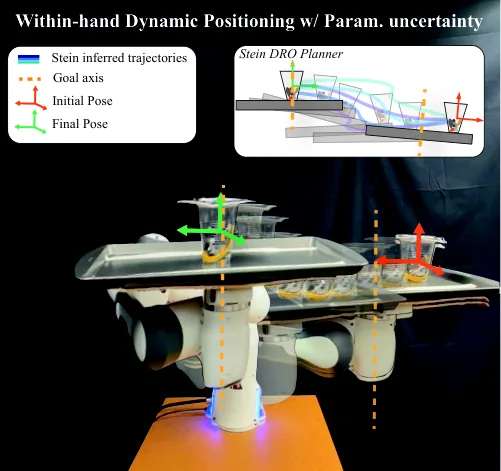 Distributionally Robust Control via Stein Variational Inference for Contact-rich Manipulation
Read paper
Distributionally Robust Control via Stein Variational Inference for Contact-rich Manipulation
Read paper
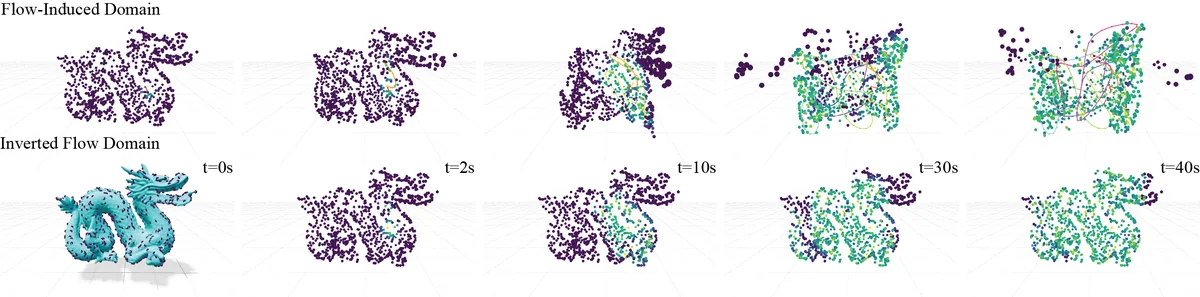 Asymptotically Optimal Ergodic Coverage on Generalized Motion Fields
Read paper
Asymptotically Optimal Ergodic Coverage on Generalized Motion Fields
Read paper
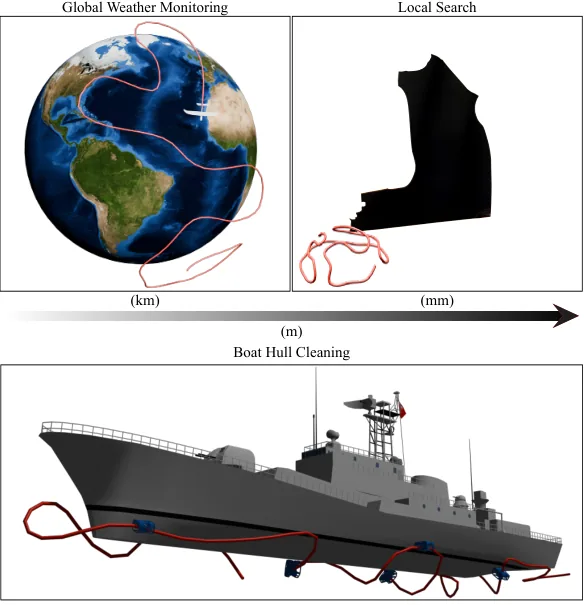 Search at Scale: Improving Numerical Conditioning of Ergodic Coverage Optimization for Multi-Scale Domains
Read paper
Search at Scale: Improving Numerical Conditioning of Ergodic Coverage Optimization for Multi-Scale Domains
Read paper
Research Areas
Numerical Methods for Adaptive, High-Dimensional Learning and Control
Robots increasingly learn from pixels and act through contact, in state spaces far too large for classical solvers. We build fast, structure-exploiting numerical methods, from parallel differentiable simulation and sampling-based model predictive control to operator-theoretic models, that make learning and adaptation tractable in real time.
- Visual policy learning through parallel differentiable simulation and sampling-based control (NeurIPS 2025, preprint, preprint)
- Optimal switching between hybrid and non-differentiable control modes (ICRA 2026)
- Koopman operator models for learning and control (T-RO 2026)
- Informative contact data for manipulation learning (RSS 2025, preprint)
Decision Making under Extreme Conditions
Flow fields, smoke, and vast or irregular spaces are where robots are most useful and most likely to fail. We develop ergodic search and coverage methods with optimality guarantees that scale from a single room to global monitoring, and that hold up when sensing is limited and time is short.
Distributed Optimization and Robust Control
When models are uncertain and decisions are spread across many particles, agents, or contact modes, optimization has to be parallel by design and robust by construction. We develop Stein-variational, distributed, and dual-control methods that hedge against uncertainty while still acting decisively.
- Distributionally robust and uncertainty-adaptive control via Stein variational inference (RSS 2026, preprint)
- Distributed optimization for discovering diverse contact-rich strategies (preprint)
- Parallel, diverse multi-agent search (NeurIPS 2025)
- Dual control for acting under parametric uncertainty (preprint)
We are recruiting!
Those interested in joining our group are expected to have strong competency in programming, optimization, systems and control theory, kinematics and dynamics of robotic systems, and rigorous mathematical theory and proof writing. Candidates should have a strong curiosity and drive to develop algorithms and deploy them on physical robots to expand the capabilities, analyze their performance, and prove reliability through mathematical rigor and repeated experimentation.
Other useful skills:
- ROS 1/2 or LCM experience
- Extensive Python and C/C++ coding experience
- Exposure to modern ML/AI autodiff libraries like JAX/PyTorch
- Excellent speaking/writing abilities
If this sounds like you then please submit an expression of interest (EOI) via this form. Make sure to list Dr. Ian Abraham, School of Electrical and Computer Engineering as a potential advisor if possible.